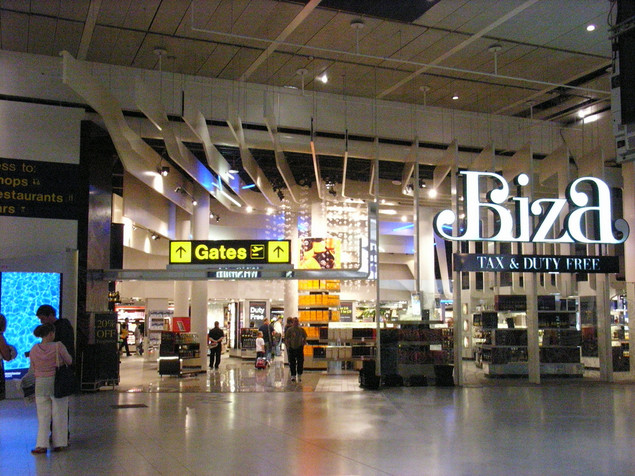
Match any journey through Manchester Airport to the duty free and luxury shopping available on departure, inflight and on arrival with Duty Free Hunter.
Manchester Airport has three passenger terminals (Terminals 1, 2 and 3). Terminals 1 and 2 are linked by the skylink, with travelators to aid passengers with the 10–15-minute walk. Terminal 3 is linked to Terminal 1 and the skylink by a covered walkway. The “skylink” also connects the terminals to the airport railway station complex (known as “The Station”) and theRadisson BLU Hotel. The Skylink started construction in 1996 and opened 1997. Expansion to the Radisson Hotel was completed in 1998 when the hotel opened.
Terminal 1

Terminal 1 is used by airlines with scheduled and charter operations, flying to European and other worldwide destinations. It is the largest terminal at the airport. It was opened in 1962, by Prince Phillip, the Duke of Edinburgh, and it is a base for EasyJet, Jet2 and Thomas Cook. Some other airlines that fly out of Terminal 1 include Brussels Airlines, Emirates, Etihad Airways, Lufthansa, Swiss, TAP Portugal and Turkish Airlines. Terminal 1 is spread over an area of 110,000 m2 (1,200,000 sq ft).
The terminal has 29 stands, of which 15 have air bridges, and is the largest of the three terminals. Gate 12 was specially adapted to accommodate the Airbus A380 which is operated by Emirates on their route from Dubai to Manchester.[20] Terminal 1’s current capacity is around 11 million passengers a year.[21] compared with an annual capacity of 2.5 million passengers when it first opened.[21]
In the Summer of 2009, a £50 million redevelopment programme for Terminal 1 was completed.[22] As part of the overhaul, which took over 2 years, a new £14 million 14-lane security area opened during April 2008. The terminal’s arrivals area has since been revamped with additional catering and retail facilities. Terminal 1’s departure lounge has been expanded with a greater choice of shops and restaurants, following the virtual elimination of the landside area, and additional executive lounges have been added. Following the 2007 smoking ban, the indoor ventilated smoking room in the departure lounge was closed, however this was replaced in 2010 by a rooftop smoking terrace to allow passengers to smoke after passing through security.
Terminal 2

Terminal 2
Terminal 2 is used by a variety of airlines, operating both charter and scheduled flights to many European and worldwide destinations. It opened in 1993 and it is a base for Monarch, Thomson Airways and Virgin Atlantic. Some other airlines that use the terminal include Air Malta, Singapore Airlines, Qatar Airways,and United Airlines. Cathay Pacific returned to the Terminal in December 2014 and operate a service to their hub at Hong Kong. Terminal 2 is spread over an area of 52,000 m2 (560,000 sq ft).
Terminal 2 has 20 gates, of which 14 have air bridges. The design of the terminal makes it capable of extensive expansion; planning permission already exists for an extension providing additional gates, together with the construction of a satellite pier. Terminal 2’s current capacity is around 8 million passengers a year, this will be extended to ultimately handle 25 million passengers a year.[21] In 2007, an £11 million project commenced to redevelop Terminal 2 by improving security facilities and enhancing retail and catering services. This has resulted in the elimination of the land-side shopping area to allow for an expanded air-side departure lounge. The ground level arrivals area has also been redeveloped with improved catering and retail facilities. Like Terminal 1, following the 2007 smoking ban, the indoor ventilated smoking room in the departure lounge was closed, however this was replaced in 2009 by an external smoking area at Gate 300 to allow passengers to smoke after passing through security. The departure lounge also has an unsupervised children’s play area at Gate 212. Terminal 2’s new upper-level security area opened during July 2008 and the entire terminal redevelopment completed during autumn 2009.
Terminal 3

Terminal 3
Terminal 3 was opened in 1989 by Diana, Princess of Wales as ‘Terminal 1 Domestic’ before re-designating as Terminal 3 in May 1998. The terminal was known in succession as “Terminal 1 – British Airways”, “Terminal 1A” and “Terminal 3 – British Airways and Domestic” before becoming simply known as Terminal 3.
In June 1998, British Airways opened their new £75 million terminal facility designed by Grimshaw Architects, this being a major extension to Terminal 3, and became the primary user of the terminal along with codeshare partner airlines (Oneworld Alliance). Terminal 3 now spreads over an area of 44,400 m2 (478,000 sq ft).
British Airways currently operates a high frequency shuttle to their main hub at Heathrow Airport from Manchester Terminal 3. It operated a shuttle to its second hub at Gatwick Airport until March 2013, but the route was dropped after a fall in demand.[23]
This Terminal now handles the majority of domestic routes from Manchester as well as some scheduled European flights. American Airlines and US Airways (until its merger with American in early 2015) operate daily flights to the USA from Terminal 3.
It is now primarily a base for low-cost carriers Flybe and Ryanair. Some other airlines that fly out of Terminal 3 include Air France, British Airways, Virgin Atlantic Little Red services to London-Heathrow (However these services are due to end on 28 March 2015), BMI Regional and KLM.
The airport has over 50 airline customers operating a global network of scheduled, charter and freight services.
North American carriers at Manchester include American Airlines, United Airlines, Delta Air Lines and US Airways. The Virgin Atlantic scheduled USA services will be joined by Thomas Cook Airlines in May 2015 with frequent services to New York and Miami.[25] Caribbean services are mix of scheduled and charter services operated by Virgin Atlantic, Thomas Cook Airlines and Thomson Airways to varied destinations including Cuba, Jamaica, Barbados, Dominican Republic and others. Airlines serving the Asian market include Cathay Pacific,Emirates, Etihad Airways, Pakistan International Airlines, Qatar Airways, Saudia and Singapore Airlines. North Africa is connected via Libyan Airlines (currently suspended) and easyJet.
Europe is connected via an extensive range of scheduled and charter services coving all major alliance hubs, important cities and holiday destinations. Scheduled airlines with a base at Manchester include easyJet, Flybe, Jet2.com, Monarch Airlines, Ryanair and Virgin Atlantic. Charter airlines with a base at Manchester include Monarch Airlines, Thomas Cook Airlines andThomson Airways.
Manchester Airport offers flights to over 190 destinations across the globe and 65 tour operators utilise the facility. Many of Manchester’s overseas routes are served by charter flights to holiday destinations, some being seasonal. The proportion of scheduled passengers passing through Manchester has increased from 43% in 1991 to 68% during 2009.
Manchester also offers more destinations than some of the biggest airports in the U.S.A., including John F. Kennedy International Airport, although it is still slightly behind the three biggest ‘hubs’ in the global aviation network – Hartsfield-Jackson Atlanta International Airport, Frankfurt Airport and Amsterdam Airport Schiphol – which each offer more than 250 destinations. However, Manchester serves more foreign destinations than Atlanta and Frankfurt (but not Amsterdam), although being much smaller in terms of total passengers handled.
Manchester Airport Duty Free Shops
Duty Free and luxury boutiques at this airport include:
Manchester Terminal 1
Biza Tax & Duty-Free
Dixons Travel
Accessorize
Bobbi Brown
Clarins
Fat Face
Jo Malone
Kurt Geiger
Monsoon
Next
Paperchase
The Body Shop
Timberland
Manchester Terminal 2
Biza Tax & Duty-Free
Dixons Travel
Accessorize
Monsoon
Manchester Terminal 3
Biza Tax & Duty-Free
Dixons Travel
Accessorize
Swatch

